
Why Payment Infrastructure - Not Crypto - Will Define Africa’s Fintech Future

Introduction: The Distraction vs The Reality
For years, crypto has dominated the global narrative surrounding African fintech.
Headlines focus on:
- Bitcoin adoption
- Stablecoins
- Peer-to-peer trading
But this narrative misses the real story.
Across Africa, speculative assets are not transforming fintech.
Payment infrastructure is transforming the fintech landscape.
Crypto adoption will not define the future of fintech in Africa.
It will be defined by how efficiently money moves.
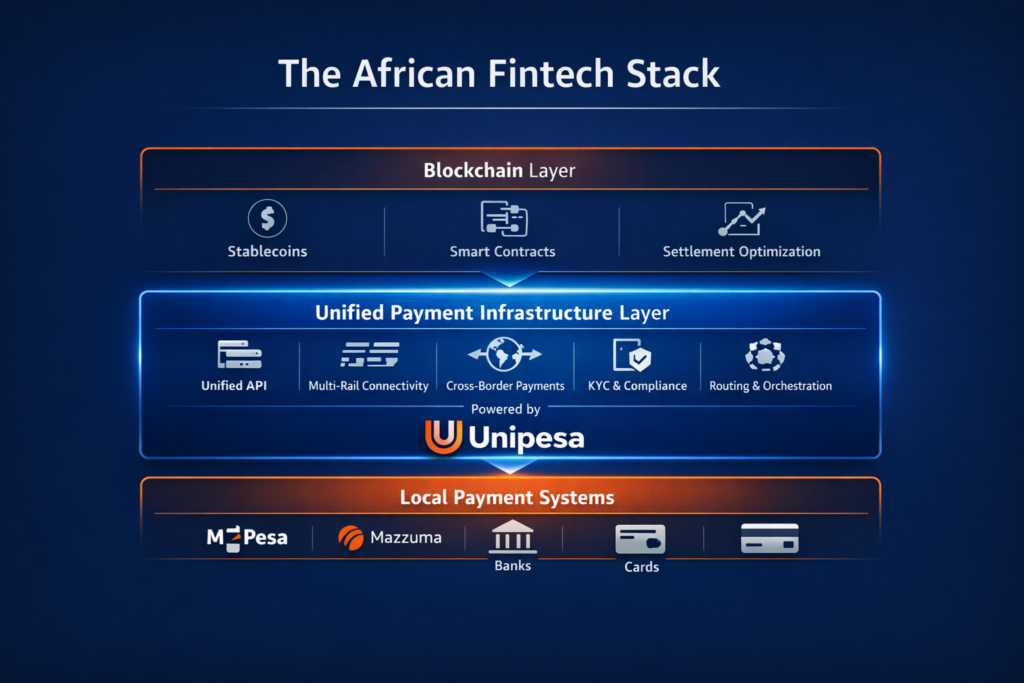
Africa Already Solved Payments Locally
Africa is not behind in fintech. In many ways, it is ahead.
Platforms like M-Pesa have:
- Built one of the most successful mobile money ecosystems globally
- Enabled financial inclusion at scale
- Created entirely new economic behaviors
Similarly, players like Mazzuma have:
- Digitized merchant payments
- Connected users and businesses
- Strengthened local payment ecosystems
These systems are not experimental.
They are:
Proven, scaled, and deeply embedded in everyday life.
The Real Problem: Fragmentation
Despite strong local systems, Africa’s fintech landscape is fundamentally fragmented.
Each market operates as its own ecosystem:
- Different payment methods
- Different regulations
- Different providers
This creates a critical barrier:
Payments work locally, but break at scale.
For any fintech, PSP, or global business trying to expand:
- Integrations must be rebuilt market by market
- Cross-border flows become complex
- Operational costs increase
The lack of liquidity is the real bottleneck.
Why Crypto Doesn’t Solve This (Alone)
Crypto is often positioned as the solution to fragmentation.
But in practice, it faces limitations:
1. It doesn’t replace local behavior
People don’t abandon mobile money for crypto wallets.
2. It doesn’t remove regulation
Compliance requirements still apply — often more strictly.
3. It doesn’t integrate existing systems
Crypto operates parallel to financial systems, not within them.
4. It introduces new complexity
Volatility, custody, and user education remain challenges.
The reality:
Crypto can improve parts of the system — but it cannot replace the system.
The Rise of Payment Infrastructure as the Real Growth Layer
What Africa needs is not a new financial system.
It needs a way to connect existing ones.
This is where payment infrastructure becomes critical.
Infrastructure platforms enable:
- Unified access to multiple payment methods
- Cross-border transaction capabilities
- Simplified integrations
- Compliance at scale
Instead of building country by country, businesses can scale through a single integration layer.
Where Unipesa Fits
This is exactly the role of Unipesa.
Rather than competing with local systems, it:
- Connects them
- Standardizes access
- Enables scalability
Through a unified API, businesses can:
- Integrate mobile money (including systems like M-Pesa)
- Access banks and card networks
- Operate across multiple African markets
In this model:
- Local players remain dominant in their regions
- Infrastructure platforms enable regional and global scale
Infrastructure vs Crypto: A Clear Comparison
| Dimension | Crypto | Payment Infrastructure |
| User adoption | Limited, uneven | Mass adoption (mobile money, banks) |
| Integration with local systems | Low | High |
| Regulatory alignment | Complex | Built-in |
| Scalability | Fragmented | Structured |
| Business usability | Niche | Core |
The takeaway:
Crypto is an enhancement layer.
Infrastructure is the foundation.
Where Crypto Actually Fits (And Where It Wins)
This doesn’t mean crypto is irrelevant.
It plays a role in:
- Cross-border settlement
- Liquidity optimization
- FX efficiency
- Alternative rails for specific use cases
But its role is:
Embedded within infrastructure, not replacing it
The most successful fintech models in Africa will combine:
- Traditional payment systems
- Infrastructure platforms
- Selective blockchain integration
The Strategic Shift: From Products to Systems
Early fintech in Africa focused on:
- Wallets
- Apps
- User acquisition
The next phase is different.
It’s about:
- Systems
- Infrastructure
- Interoperability
Winning companies are no longer building apps.
They are building financial layers.
Why Infrastructure Companies Will Win
Infrastructure companies have structural advantages:
1. They scale across markets
They are not tied to one country.
2. They benefit from ecosystem growth
More fintechs = more demand for infrastructure
3. They enable, not compete
They work with wallets, banks, PSPs
4. They become deeply embedded
Once integrated, they are hard to replace
This is the key shift:
The most valuable fintech companies in Africa will not be consumer apps.
They will be infrastructure providers.
The Future: Invisible, Unified, Scalable
The future of fintech in Africa will look like this:
- Users interact with simple payment experiences
- Businesses operate across multiple countries seamlessly
- Payments move instantly and reliably
- Complexity is abstracted away
Underneath all of this:
- Local systems continue to operate
- Blockchain enhances efficiency where needed
- Infrastructure platforms connect everything
Conclusion: Focus on What Actually Scales
Crypto will continue to evolve.
New technologies will emerge.
But the defining factor of Africa’s fintech future will be simpler:
Can money move easily, reliably, and across borders?
The answer to that question will not be found in speculative assets.
It will be built through:
- Strong local systems
- Scalable infrastructure
- Thoughtful integration of new technologies
And the companies that understand this and build accordingly will define the next decade of fintech in Africa.